Simon Mark Smith’s Autobiography
CHAPTER 12
To see other chapters click here
Betrayal
Betrayal lies at the heart of love
1973 – Roundshaw
Something hit the ground. I looked down to see one of my toy soldiers, sprawled, gun in hand, across the lino. The friend I was saying goodbye to looked at me and smiled. At first, I was confused about where it had come from but then, still grinning, “my friend” looked at me and let the whole platoon fall from inside his coat.
* * *
My politically aware Action Man radioed ahead. “We have one man, sorry person, down…..” “Who is it?” I radioed back. “I’m sorry sir, I know this is a bit of a cliché, but it’s Truth”.
* * *
It was “us and them”, and “you and me”. This was the dislocated sense of community that underpinned our neighbourhood on Roundshaw. There was a sense that people outside the estate saw us as “a bad lot”, and we were the enemy and definitely their enemy. But given my enemy’s enemy was all around me, linked by the label of being the underclass, we were connected, whether we wanted to be or not.
Where we lived was rough, and many of us lived by the sword, knuckle duster, knife, shotgun or fist. Those that did thought they were tough and everyone else was soft and scared of them. Those who lived outside of the estate were the haves, we were the have-nots, so, resentment festered in both us and them.
My ‘friend’, the soldier stealer, saw me as “a have” and therefore I was a legitimate target. The victim makes a victim.
* * *
2006
All I need is the air that you breathe and for you to love me
I used to think that at the root of most “evil” acts you’d find betrayal. Even in the bible, the devil falls from grace as a result of an oscillation of betrayal.
An oscillation of betrayal is where one even very small perceived act of betrayal, whether it occurred or not, is then met with another, normally slightly greater one. In turn, this volley continues until eventually, a cataclysmic one takes place. In relationships, if you follow the path of a break-up backwards you’ll find it often starts with the perception of miniscule betrayals.
To feel betrayed normally requires an expectation. Whether an expectation is just or unfair is a matter of debate, but all the same, expectations stand nose to nose with betrayal. Some people might say that at the heart of our suffering, it’s not betrayal, but expectation. I wonder though if it’s also a matter of truth and understanding, or more accurately, a lack of them. We suffer because we are unable to truly understand what has happened to us, or those who’ve betrayed us and why.
This probably isn’t much help really, I mean if we can’t get to the truth of hardly anything we might as well make the most of feeling betrayed. At least that saves us from battering ourselves for having expectations, and lacking understanding of the bigger picture and let’s face it, feeling resentful is much more satisfying in the short term.
* * *
2006 – Kate’s
I came in tonight, I was home later than I said I’d be. When I got in Kate had kindly kept some food back for me. I said I was sorry that I was late and as I passed her I hugged her, she told me to eat my food as it was getting cold. I continued to maul her a bit and she repeated that I ought to eat up.
As I sat down to eat she told me how annoyed she was that I didn’t stop hugging her when she’d asked. The proceedings then took a turn for the worse because I felt she was making a meal of the incident. She told me I wasn’t listening to her, I said she was being overly controlling, and within seconds the whole evening was ruined.
* * *
November 2006
A year ago I sat in my kitchen while Sean, a neighbour and friend who’d already done building work for me over the preceding 20 years, went over the plans and schedule of works an architect had drawn up to develop the property I’d recently bought. He told me that it would cost from £55,000 to £75,000 depending on what was included. He said as I was a friend he’d only charge me a fee for acting as a coordinator, and he’d fit the electrics within this fee. Outside of that, of course, I’d have to pay the workers’ wages and materials. I agreed and just after Christmas, the men started working on my place. I started the project with £38,000 in the bank and realised that I’d have to borrow the remainder.
Sean told me that the job would take 16 weeks but by the 12th week I’d spent £45,000 on wages, materials and his fee and we were nowhere near finishing the job.
When I talked to Sean about it he said, “Well you obviously can’t afford to finish the job, can you? I’ve got some friends who might buy it from you.”
I went back to my mortgage company which lent me a further £25,000 and told Sean I could afford to finish it after all. A few weeks passed, and after a further £10,000 had been paid very little progress was made.
So, Sean and I sat in a café and went through the remaining jobs and what I’d have to budget for. Within a week a job he’d told me would cost £2,500 came in at £5,500. At this point, I made it clear that I needed accurate quotes for the remaining works. He told me to write out a list of what I thought remained, he’d write one too and we’d agree what jobs needed to be done and that he’d be held to those prices.
I typed up the job list and left it on-site for him. A few days later one of the large burly workmen came up to me and said, “You’re a cunt for writing that list”.
I asked why he thought that.
“Well who are you to say what needs doing and how long it’ll take”
“I’m just doing what Sean asked me to do.”
Another week went by and again barely anything got done.
I woke up feeling angry about being taken for a ride and on the way to the house I discussed what I should do with Kate, she took on my feelings and fed back to me how angry it made her feel. By the time I approached my house, I was extremely wound up. If I’d had a gun I’d have walked in and shot each of the builders, firstly in the kneecaps, then in the elbows and then in the stomach. Fortunately, I only had a Swiss Army knife, so the worst I was likely to do was peel off a lid from a bottle of beer and drink it in front of them.
When I got to the property I went to find the list of jobs I’d written previously only to find it had shit smeared all over it where someone had wiped their arse on it. I asked the big burly builder if he’d done it and he said, “No it was Ron.” Ron was a carpenter who was particularly slow.
I went quiet, had a piss, and just as I came out of the loo, Sean arrived. I said I needed to talk to him in private so we went outside.
“Sean, I’m pissed off,”
“Why, what’s the matter mate?”
“Well, there’s a few things. Firstly, I don’t like being treated with disrespect by the guys. One thinks it’s ok to call me a cunt, the other has wiped his arse on my documents, and on top of all this, they’re taking the piss by working slowly. You said this would be almost finished two weeks ago, but there’s hardly any change.”
“Do you want me to pull them off the job?”
“I want what’s best for me. I want the job done for the agreed price. If they don’t agree to work for a fixed price send them home.”
“Ok, I’ll talk to them.”
I went off for a while and decided I didn’t want Ron in my house anymore. He’d shown his true colours and was a liability to my security. What he thought of me was of no interest to me but his actions were. So I came back to Sean and told him I wanted Ron off the site.
“How about I run him into the ground for a week, make him do loads of the shit work and get someone else in to do the good stuff?”
“Ok do that”
The next day I turned up and the builders were packing everything away.
Sean greeted me with, “They’re not willing to work for a set fee” with a, ‘told you so,’ look on his face.
“Well, they can get lost then can’t they?” I replied with a ‘Do I look bothered’ face.
The house emptied and work came to a stop. A bit later on a couple of the builders came back to me and said they were willing to work for a set fee per job but they hadn’t wanted to look like they weren’t supporting the others. So, for a few weeks, the work went on.
I started to bring in people independently and paid those who’d agreed prices with me directly. As if I’d entered a completely different dimension of reality, I had people coming in on Saturdays, whereas beforehand they were leaving work early on a Friday – “POETS day” they called it, “Piss off early tomorrow’s Saturday.”
One of the guys I brought in independently was called Trevor, and although Sean had introduced us to each other because we were both songwriters, Sean hadn’t wanted him to work on the job. However, when Trevor gave me a quote for decorating that was far lower than Sean’s, I naturally went with the better price. In turn, Trevor introduced me to a tiler who also offered to do the tiling for a third of Sean’s price. Sean was not happy about this and told Trevor he shouldn’t be poking his nose into business that didn’t concern him and should’ve approached him with quotes that he would decide on as he was the foreman.
Trevor is black, and it wasn’t long before racist graffiti appeared on my walls.
Every quote Sean gave me came in at double the amount and took two to three times longer than expected, yet all the jobs I set up came in on budget and sooner than estimated. One Friday, as I paid the workers Sean told me he was no longer on the job, that I had insulted him by slyly taking over. This had insulted him in front of the others. So I pointed out that I’d now spent £90,000 and a further £30,000 worth of work was still outstanding. He said his initial costing was just a guide price. I then told him, that given he was unable to keep to any agreed price or time limits, I felt it was time for me to take responsibility. To him though, none of this mattered, his main concern, allegedly, was, that I’d insulted him. This became his main focus in terms of his resentment of me and from then on, whenever I’d drive past him, he’d mutter and look away from me in disgust. He walked off but things didn’t end there. He kept on asking for bills to be paid for materials, some of which were not even for my job. I always tried to be fair and pay what I owed, but he didn’t do the same for me.
I subsequently found out that he had a history of getting his customers into far more debt than they’d anticipated and then getting them to sell their property to him at a low price because it was unsellable and they were desperate.
It didn’t make sense. What had I done to deserve such bad treatment? Perhaps firstly there was a perception that I would be making a good profit out of this venture and secondly, the friendship between us was worth very little in comparison to his allegiance to his workers. – There is, after all, honour amongst thieves -. But maybe, to him, anyone stupid enough to fall for his con deserved what they got and ultimately he had to put food on the plate for his family. Still, I couldn’t help but feel betrayed and consequently wanted to strike back at him.
From the moment Sean and I parted company, I felt a strong sense of relief and striking back would have meant continuing our connection be it just emotionally. So, at least right then, I thought it best to enjoy the disconnection.
There were practicalities, as there is with most separations. I knew that I had to take over and find a way forward but the responsibility was mine, so, over the next three months, I had to hire and fire workmen and organise everything.
If ever there was a good way to learn management skills this was it. One of the big lessons was nearly all people you deal with will overcharge and underperform unless you make it hard for them to do so. There are good people around, but learning who you can be safely dependent on is a long drawn-out process and finding them is like finding good friends. It takes time and the ability to limit what you’ll accept as ultimately, you get what you settle for.
The result of Sean’s betrayal was I made a lot less money than I thought I would. Consequently, this resulted in a larger mortgage than I would have had and that meant having to work more and for many more years than I’d hoped. Also, the area I’d grown to love over a twenty-year stay became one I no longer wanted to be in because not only was Sean a neighbour but the residue of this whole misadventure was all around me. Fortunately, I still made a profit but perhaps it was time to move off anyway. Of course, there were positives such as learning skills that might see me well in the future, but given a choice, I’d rather not have been one of his victims.
* * *
2006 – Fulham
Trevor walked past Sean the other day and said, “Hello Sean”.
“Don’t fucking talk to me”
“Why? What have I done to you?”
“What haven’t you done to me?”
* * *
1975 – Roundshaw
I’m riding my bike through Roundshaw. There are three kids playing football. As I pass by, one of them starts calling me names. He’s a boxer and has a reputation for fighting well. I continue on my way but start to feel overwhelmed by a feeling of fury. I double back and park my bike at the bottom of the stairs that lead back up to the deck where they’re playing. I walk up the dark steps which smell of piss and radiate coldness. As I stand at the top of the stairs, I try to work out how to do what I have to do but needn’t have worried. The ball bounces to where I’m standing. The kid walks over to it and passes me. I step out, and he turns around looking shocked, I kick him in the stomach, he falls backwards, hits the wall, drops down, curls up and tries to cry, but he can’t breathe.
“That’s what you get for calling me names,” I shout in his face.
I walk off and from then on he always showed me respect.
* * *
The pleasure that comes with teaching someone a lesson can easily blind one to the reality that the world is full of people who aren’t going to show respect, and many of them can’t be beaten into submission either. But even in my own home – even if it was a building site – I have seen what results in an enemy being let in to do whatever they want. It ends in the destruction of one’s well-being. Sometimes it’s a fight for respect, and sometimes it’s about survival.
One of the lessons I learned from Roundshaw was how important honour was. To be a coward, well at least for me, hurt far more in the long run than standing up to a bully and getting physically hurt. I also came to realise that the maxim, “Don’t be right, be clever” sic well worth keeping in mind when it comes to conflict.
Sean had taken me for a ride. Either he was inept and wasn’t willing to take responsibility or he’d seen me as a sucker to con. Whichever one it was, he had no respect for me. Deep down I wanted to kill him but I also knew that letting go of all of this and seeing the positive aspects would be for the best. Forgiveness is the way to freedom, however, even now, decades later, a part of me wants vengeance.
* * *
1974 – Roehampton Hospital
A boy with no legs is sitting on my chest, while a girl with ginger hair and both short arms and legs, is lying across me, holding me down with her weight.
Clive, the legless boy shouts, “Say sorry for telling on us for smoking.”
“No,” I snarl
“Say sorry or I’ll hit you.” His fist held high, ready to strike.
“Get off! I’m not sorry”
Clive punches me in the eye and I scream in agony. A few moments later one of the nurses pulls him off. The ginger-haired girl, Veronica, is filled with guilt and admiration simultaneously. This moment connected her and me and 33 years later we were still the best of friends. My determination not to submit to Clive’s bullying struck her to the core.
* * *
Dream 14th November 2006
I’m sitting on the roadside, while Kate sits on a bench next to me. I’m getting dressed and putting on my underwear. A car goes by and a middle-aged black man makes eyes at Kate. I watch him then check her out to see if she flirts back at him. I ask her if she did and she says, “No, can you imagine what would happen if I made eyes with every guy who did that to me?” she laughs, “You learn from a young age not to look back at every man who looks at you.”
I’m now in my Aunt Anne’s house standing in the back bedroom. A woman is in the loo and I’m hovering near the doorway of the room so I can speak to her when she comes out. Perhaps she has a partner downstairs and I want to get her alone for a moment. When she comes out I ask her into my room. She does so and we stand in front of a mirror. She’s short, petite, with big brown eyes, and short dark hair that wraps around the edge of her face. I say, “I want to tell you something, don’t be embarrassed, but I’ve always felt something for you.”
She says “I know, and maybe in six months when I split up with Mike we could try to get together”
With that, I hoist her onto my back to show her how strong and comfortable I am. A shower is sticking out of the wall and has water pouring from it. It’s pouring on us. I start to worry that the furniture and clothes strewn across the floor will get soaked so I check if there’s a plug hole in the floor. I find it but also realise that her back is wet too. She says it doesn’t matter.
I don’t want to wake up, but when I do, I move across the bed and cuddle up to Kate.
* * *
As I was writing this I started to get the sensation I had as a child of the smell and taste of anaesthetic. It filled me with fear. The irony is, the anaesthetic protected me from unbearable pain, but the association I made wasn’t of protection, but pain and nausea. I thought just now of how alone I would have felt when that mask went over my face, its big black overly sweet-smelling membrane felt like a hand trying to suffocate me. So much of what is good for us looks bad up close until we see it in a wider context and no doubt the same goes for what we think is good for us. There’s a kind of betrayal in that process, but who’s to blame, us for our inaccurate perception, or the thing for not revealing the truth?
* * *
2007
A year and a half has passed since I walked out of Kate’s place wondering if that would be the last time I’d be there. I did return though, but the relationship had changed. It didn’t seem so at first, but a week and a half after she’d returned from the holiday I started to notice it. Instead of wanting to make love on a daily basis, there was a 10-day gap. When I questioned her about it she said I was making an issue of it by bringing it up but still, I wanted to know if she didn’t fancy me anymore. Actions speak louder than words.
* * *
2007 – Marcia
Marcia is a painter. She’s the partner of someone who did some work for me and he thought I ought to meet her, so, one evening we met up at the Chelsea Arts Club. At one point Marcia and I discussed painting a picture together and as we did a man sitting nearby overheard us, and told us he’d be interested in filming us doing so. Things developed and within a month we were all meeting every week, Marcia and I painting together, while Jack Pizzey, the filmmaker from the club, and his cameraman, Sam Small filmed us.
The painting’s themes were mainly centred around grief. The bit of grieving after the initial mourning period, the bit which can last a lifetime, the bit where “the shadows of those we’ve lost illuminate our internal world”. In other words, a world where we’re no longer trapped in the grave of the one we love but have come to accept we have lost them, but can connect with them, at least to a degree, where we may speak with them, go walking in dreams together, hold them, kiss them goodnight, tell them we love them, know we will always love them, and one day, hopefully, be with them again.
The painting came from the pattern of brush marks we made across the canvas, and ended up as a picture of a man half lying in a stream, with his eyes closed while a woman who looks as if she’s illuminated stands close to him in front of a vividly coloured and stormy sky.
During the process of making this image, which has a slightly classical look to it, I decided I wanted to cut out the figure of the woman, then photograph and scan her before burning the bit we cut out. Once that was done the figure was printed out and stuck back into the same position in the painting. This was done to make a point about how important it is for us to use painting and other more modern forms of capturing images to hold on to the visual form of something or someone we’ve lost.
The juxtaposition of the modern and classical ways of creating images – painting and computer graphics – also highlighted how readily we look back to eras when painting seemed as if it couldn’t get better, and anything since then has been seen as sub-standard. As if we too, the viewers of art, can get stuck in the grave of bygone eras.
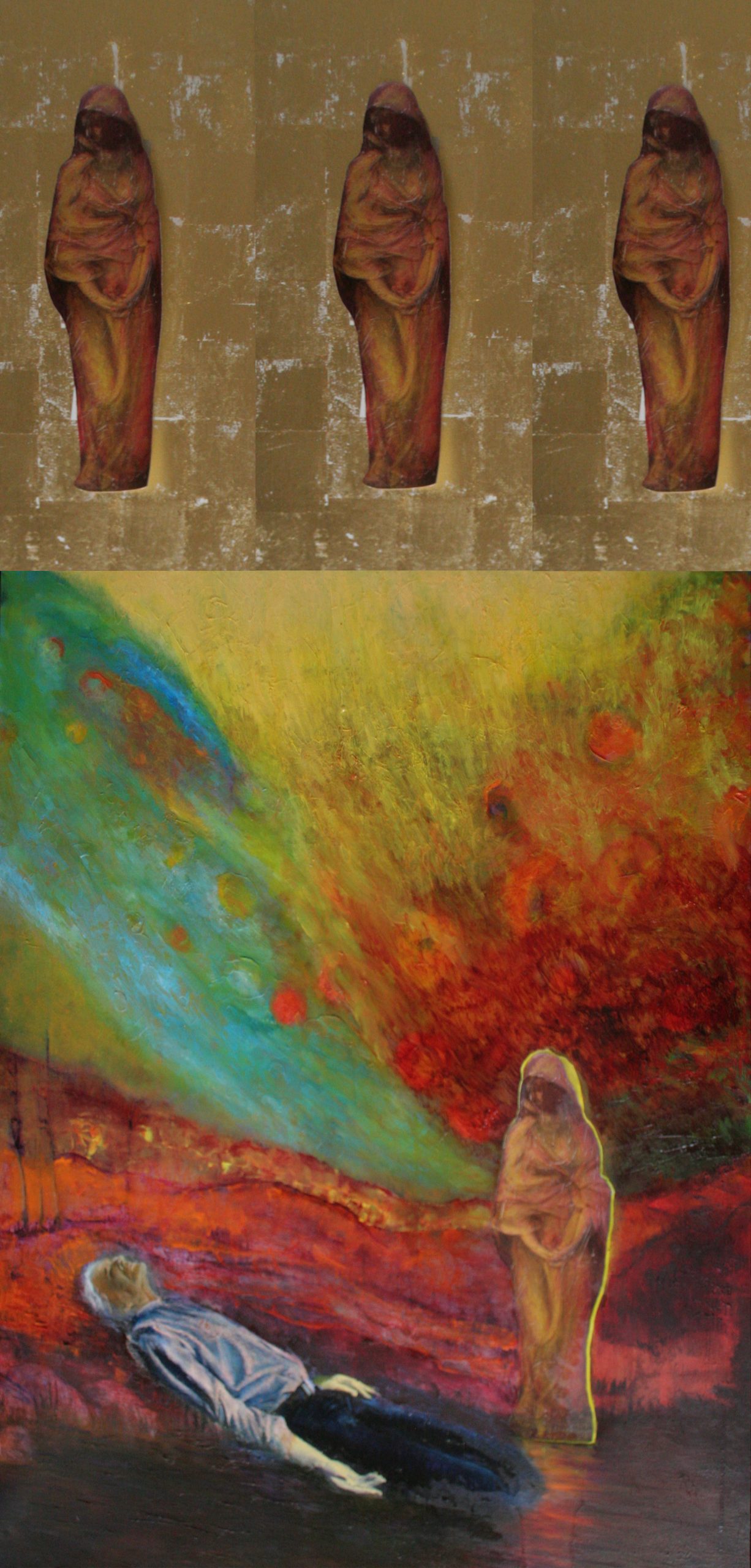 Painting I did with Marcia K Ellis
As the film progressed the cameraman, Sam, interjected with comments aimed to stir up a reaction, such as, “Painting died after Van Gough”, or “You’re just making this up as you go along, your painting is meaningless.” And “Van Gogh didn’t need computer graphics.”
At one point Sam and I had a heated discussion about how the painting would be read very differently by onlookers compared to how we’d intended it to be viewed. Sure enough, a couple of people came in and indeed, felt confused about what it was we were trying to say. Of course, there are many philosophical directions one can take regarding this matter, however, even though the air was thick with resentment from both sides, the conversation took an unexpected turn, starting with Sam asking me if I felt I’d dominated the project.
“Partly,” I said.
“I think you have.” He said, then paused and asked, “Do you think you’re a dominant or submissive person?”
“What do you mean?”
“Well, a dominant person likes to take control, make decisions and have things go their way, whereas a submissive person is more nurturing, likes to take a back seat and doesn’t like making decisions.”
“I suppose in terms of those definitions I’m a dominating person then”
“So what kind of women do you end up with then?”
I laugh, “Dominating ones.”
“Maybe that’s why your relationships don’t work? A dominant person needs to be with a submissive partner and vice-versa.”
I’m struck by this insight but realise I seem to oscillate between being dominant and submissive depending on the situation. “The only trouble is,” I stay, “If someone shows any sign of pulling away from me, I suddenly start to feel weak and become submissive.”
“Ah so maybe you attract women who want a dominant man, submissives, but then find they’ve got a submissive partner. No wonder your relationships collapse”
I’m almost taken in completely by the simplicity of this way of seeing things, but that thought about my changeability stops me from seeing it as the whole story. Still, there was something that resonated in what he said.
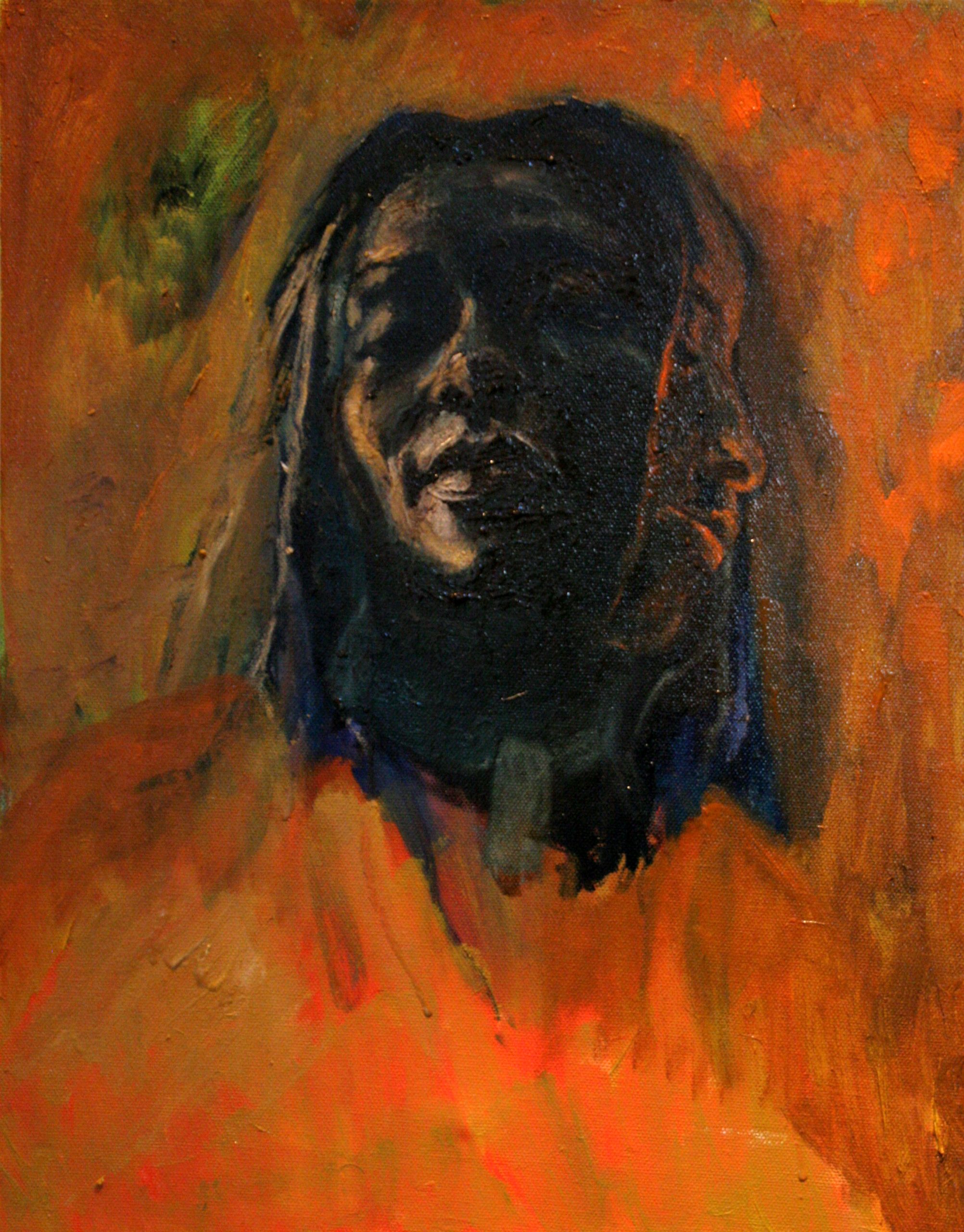
Portrait of Marcia by Simon Mark Smith
* * *
November 2006
Kate and I had an argument a couple of days ago. I walked out after she told me she didn’t find me sexually attractive anymore and I had put the dampeners on her sexual feelings towards me a year ago, when I had said that if she wasn’t interested in me sexually then I wouldn’t stick around. She felt it was an ultimatum whereas I saw it as an obvious point about relationships. The irony was, a year later we’ve hardly had any sex but I’m still here with her. After a night of being apart, I yearned to be with her and to be home. But after this last argument, it felt like an end date had been stamped upon our relationship; we might not want to see it, but we both know it’s there.
The thought of not having this home together anymore and being alone in the house I’ve just bought on the seafront on the South Coast 60 miles away, feels scary. Even if separating might make room for a dream girl to come to me, the idea of parting from Kate fills me with dread. I can’t see beyond the pain of the present, can’t see the possibility of joy in pastures new and without this vision, it’s so easy to get trapped in the grave of a dead relationship.
* * *
1988 – Somewhere and Nowhere
The engine is pulsating as I pull up on a side street. We’re in a small town. It’s dark, everything’s wet but it’s not raining. I get out of the car to look at the damage. There’s a dent where the brick landed on the bonnet. The car was pristine until that moment. I wipe off the dirt hoping it’s just a surface scuff, but it isn’t.
I walk to the back of the car open the boot and pull out a large powerful air rifle which I pass to my friend as I get into the driver’s seat. “OK,” I say, “let’s get ‘em.”
I’m not sure who’d started it, but all it took was a bad look. From the viewpoint of the two guys who’d thrown the brick at us, it must have been a strange sight. It’s nighttime, and the sunroof is open with the passenger, like a tank turret soldier, standing up through it with a large air rifle aimed at them.
“You fucking cunts!” I shout as my friend pulls the trigger. The smaller of the two falls backwards, yelps and doubles up in agony. We drive off at top speed. The adrenalin is pumping through us and for a minute we say nothing. Then I look at my mate and say, “You got the wrong one, it was the big one who threw the brick”.
“Did I?” My friend says most apologetically, “Ooh, sorry about that.”
He’s still holding the gun and as the messenger tends to always get it, I feel I ought to add, “Oh well not to worry, at least the other bloke will feel a bit guilty”.
“Aye, there is that” he says.
* * *
1970 – The Train
When my friend was eight years old, he lived in a house on a small council estate on the outskirts of a mining town. His father was a miner and a father of six. On non-school days his mother would let the kids out in the morning to play in the fields and call them in for tea as evening fell.
A few miles away across fields of long wet grass my friend and a couple of his brothers would play amongst the coal trucks of trains that took the coal from his father’s mine away to far-off destinations in “the smoke”. The trucks were black and sooty and towered over the children and had buffers that would push against the next truck’s buffers when they started to move. They acted as shock absorbers, but no amount of absorption could have taken away the shock my friend experienced when one day the train started to move and his right forearm became caught between two of the buffers. He screamed out but the screeching of the wheels took his cries for help and cast them into shudders. His brothers played on at first and when they realised what had happened chased the train the two miles to the depot. Every sleeper that ran along the track bumped against my friend’s foot until by the end of the journey only a crushed and bleeding stump was left.
The train driver who found my friend came to the hospital to visit him every day for months; the train company however fought off any compensation claims, citing that notices warning children not to play on the tracks had been ignored.
Once out of the hospital, my friend was taken to a residential school for disabled kids. In the holidays he’d come back to his family home, but after just a few hours, would want to go back to school because at least he’d get three meals a day there, whereas at home he’d be lucky if he got one.
In my friend’s hometown, life was pretty much mapped out for most people. However, there was no route marked upon it for a footless and armless man in a mining village. If a man didn’t have a fully functioning body, he was a nobody. But when Margaret Thatcher closed the mines, and hopelessness filled every street, my friend realised that somewhere in this catastrophe were opportunities waiting to be found.
* * *
11th April 2007
“Please Simon, leave Kate. Not just for her sake, but for yours too.” These are the words of Kate’s friend to me at a party the other night. She’s the one who, on the night we first met, couldn’t believe Kate was even thinking about getting together with me. I know anything I say will be repeated to Kate, so, I say, “Whatever will be, will be”, and she, like us, “should just wait and see what happens.”
Kate and I had a big row before we set off for the party. Something had happened where I felt she’d been selfish, she thought I was being overly nasty about it, I didn’t feel want to apologise and she wasn’t going to forgive me. We got to a point where we had to stop speaking as we weren’t getting anywhere trying to talk it out.
The next day went well though. Kate had come down to my house in Eastbourne where some of our friends joined us. We ate together, sat on the beach, chatted, went for a drive to Birling Gap, walked along the base of the cliffs, had a drink in an 11th-century pub, and then waved our friends goodbye. We curled up on the sofa together for a while, then exhausted, got into bed and fell asleep in each other’s arms.
The next day the sun shone brightly, Kate went running along the shore and, once she got back, we had breakfast, then drove towards Brighton. On the way, we stopped at Alfriston and sat in a pub where we started to talk about petrol money. Within seconds we were into a full-scale argument. We left soon afterwards and continued on our journey to Brighton, still arguing, only it kept escalating. By the time we hit the traffic lights at Rottingdean, we decided it was time to split up. There was one thing we agreed on though and that was no sex and frequent arguments were not a good basis upon which to build a relationship. As we got to Brighton station, I pulled up at the drop-off point, went to the back of the car and opened the boot. Kate took out her bags and looked at me.
“Do you want to come into the station with me?” she asked.
I shook my head slowly, “It’s probably better if I don’t.”
She put her arms around me and I felt her start to cry, at which point I felt an overwhelming sense of loss and pain. I wanted to plead with her not to go but I knew it was the right thing to do. We both held on to each other crying for a few minutes, then she walked off into the station while both of us sobbed. People could see our trembling faces, someone asked me something, but I could hardly speak. I saw Kate wave at me, so I waved back. I drove home and every few miles I got a surge of tears. This sadness, this separation, was partly the consequence of betrayal. Somewhere in the relationship, an oscillation of betrayal had started between us, starting small, it bounced back and forth between us unchecked. Eventually, I no longer wanted to listen to what Kate had to say, she didn’t feel listened to, and the relationship got on a train and made its way to the smoke without us.
* * *
End of chapter 12